
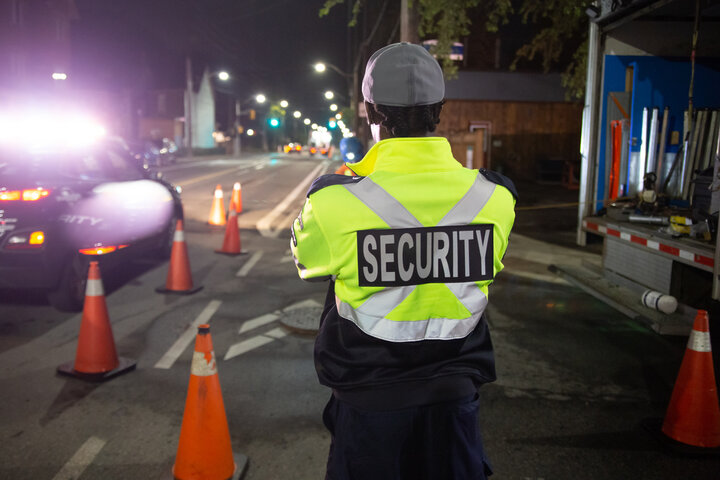
Toronto’s construction boom and growing residential density have made the city one of the most active markets in North America for private security services.
High-rise condominiums, active development sites, and mixed-use commercial properties are all operating in an environment where property crime is real, liability is serious, and the guard at your entrance is your first line of defense.
Choosing the wrong security company is not just a budget problem. It creates legal exposure, erodes tenant trust, and leaves your site vulnerable at exactly the wrong moments.
According to Astute Analytica, Canada’s security services market was valued at $6.7 billion in 2023 and is projected to reach $9.4 billion by 2032. More providers means more options. It also means more operators competing on price rather than quality.
This guide breaks down what to look for, what questions to ask, and what actually separates a security partner from a warm body in a uniform.
Looking for security services in Toronto or Ottawa? Contact Sentry Security Group to discuss your site.
Understand the Stakes Before You Sign Anything
Property crime in Toronto is not abstract.
Toronto Police Service data shows the city recorded 6,092 break-and-enter incidents in 2025, roughly 17 per day. Theft over $5,000 rose 6% that year and has climbed every year since 2021. For businesses and developers with equipment, materials, or high-value assets on site, that trend has a direct cost.
Construction sites carry particular exposure. Research from Ontario Construction News found that:
- Theft impacts 63% of construction firms every month and 21% every week
- $46 million in construction equipment is stolen annually in Canada, with $15 to $20 million of those losses in Ontario alone (Aviva Canada / OPP)
- Only 21% of stolen construction equipment is ever recovered
- Approximately 70% of construction site thefts occur at locations with inadequate or no security
The risk profile for condominiums is different but equally real. Statistics Canada research found that high-rise condos with six or more floors are 60% less likely to experience burglary than single-family homes.
That figure, however, depends heavily on access control quality, camera coverage, and on-site security. A building with an undertrained or unsupported guard does not get those numbers.
Before evaluating any provider, get specific about what you are protecting and what a failure would actually cost, in replacement value, project delays, insurance claims, and liability.
What Cheap Security Actually Costs You
Rate shopping is the most common mistake property managers and developers make when sourcing security.
The difference between a low-bid provider and a professional firm can be as little as $2 to $5 per hour. Over a 12-hour shift, that is $24 to $60. It feels like a reasonable saving. It rarely is.
“When it comes to security, you get what you pay for. Saving between $2 and $5 an hour might seem good on paper, but the reality is it’s very dangerous. You’re going to end up spending much more money in the long run because you’re not getting the best security possible.”
Bryan Bultz, CEO, Sentry Security Group
That price gap is exactly where the difference between a rookie and an experienced guard lives. Here is what that gap actually represents:
- Entry-level guards (under 6 months experience): eager but without site-specific judgment, de-escalation skills, or experience managing access control under pressure
- Experienced guards: use-of-force certified, verbally trained in conflict management, and familiar with the specific dynamics of your property type
The liability angle matters too. Under Canadian premises liability law, property owners and managers have a legal obligation to ensure the safety of people on their property, particularly when criminal activity is foreseeable.
A security company that sends an undertrained guard to a high-risk site is not just a vendor problem. It becomes your exposure.
Ask any prospective provider directly what they pay their guards. A company billing $24 per hour while paying minimum wage is not running a sustainable operation, and the quality of personnel reflects that.
Guard-to-Site Matching: Why One Size Has Never Worked
The most overlooked factor in security procurement is fit.
A guard who performs well at a downtown retail concierge post has a completely different profile than someone equipped for overnight construction site surveillance. Treating all security as interchangeable, and selecting purely on price or availability, produces predictable failures.
“Every job that we take requires a customized solution. Every job requires the right individual.”
Bryan Bultz, CEO, Sentry Security Group
Proper guard-to-site matching starts before deployment. A competent security company will assess your site’s specific risk profile, including:
- The nature of the property and its primary use
- Hours of peak vulnerability and known incident patterns in the surrounding area
- The type of people moving through the space and the most likely incident scenarios
- Any site-specific compliance or access requirements
For a construction site, that typically means a guard with experience in perimeter monitoring, access log management, and emergency services escalation.
For a residential condominium, the profile shifts toward someone comfortable with tenant interaction, FOB access systems, and de-escalation of low-level disputes without unnecessary police involvement.
When evaluating a provider, ask directly how they match guards to specific sites. Vague answers signal shift-filling, not problem-solving.
Questions to Ask Any Security Provider Before Signing
- What is your vetting and background check process for guards before site deployment?
- How do you match individual guards to specific site requirements?
- What is your guard turnover rate? Industry averages range from 100% to 400% annually. A stable roster matters for site familiarity and consistency.
- Do your guards receive site-specific post orders and a verbal briefing before starting?
- What is your coverage guarantee if a guard does not show for a shift?
- How quickly can you deploy a replacement if an issue arises mid-contract?
Want to see how Sentry approaches guard-to-site matching? Learn about our security services.
What a Security Guard Is Actually There to Do
There is a persistent misconception among clients, especially those hiring security for the first time, about what a guard’s primary function is.
Security guards are not enforcement officers. They do not arrest people. They are not trained to physically intervene in most scenarios. Their core value is deterrence: the visible presence that makes a would-be thief or trespasser recalculate.
Research from Ontario Construction News indicates that visible security measures, including guards combined with cameras and perimeter controls, can reduce crime rates by up to 35%.
The guard’s presence is doing most of the work. When that presence is undertrained or inattentive, the deterrent effect disappears entirely.
“The true value of security is peace of mind. You can’t put a price on that. Our guards protect residential communities. They’re the first line of fire. They stop the wrong people from coming in and make sure the community is safe.”
Bryan Bultz, CEO, Sentry Security Group
For condominium managers, this reframe has practical value. Residents do not experience security as a technical function. They experience it as a feeling.
Whether they feel safe in the parking garage at 11pm. Whether the lobby feels controlled. Whether there is someone who actually knows who belongs in the building. That feeling is built by a guard who is present, professional, and consistent.
For construction site managers, the value is financial. The 70% of site thefts that occur at locations with inadequate or no security represent real, recoverable losses.
A trained guard on a 12-hour overnight shift at an active development site is protecting millions in materials and equipment. The cost is a fraction of a single theft incident.
Reporting and Accountability: What Most Clients Overlook
One of the clearest gaps between professional security providers and low-cost operators is what happens after a shift ends.
A guard who shows up, stands in a lobby, and goes home leaves no record of what occurred. A professional operation uses digital reporting tools to document every patrol, every access event, and every incident in real time.
This matters for several reasons:
- Legal protection: if something happens on your property and you need to demonstrate that reasonable security measures were in place, a documented activity record is the evidence that holds up
- Guard accountability: guards who know their activity is logged are less likely to abandon their post or cut patrols short
- Incident response: real-time reporting enables faster coordination with law enforcement and reduces time between incident and response
“If you go the classified route and don’t share information with your guards, how do you expect them to take pride in what they’re doing? They have to feel supported. When they’re not supported, a failure is likely to happen.”
Bryan Bultz, CEO, Sentry Security Group
The best security companies build accountability deliberately. Guards receive written post orders and a verbal briefing so they understand the client, the property, and why the protection matters.
That context produces guards who are engaged rather than just present, and engagement is the difference between a real deterrent and a placeholder.
When evaluating providers, ask for a sample incident report and shift log. Ask what platform they use for digital reporting and whether you have client-side access.
Transparency in reporting is not a premium feature. It is a baseline expectation for any serious operation.
The Bottom Line
Canada’s security services market is projected to reach $9.4 billion by 2032. The sector is growing because demand is growing.
That growth has also brought more providers competing on price, and more clients making decisions based on rate cards rather than actual capability.
For property managers and developers in Toronto, the decision is not whether to hire security. It is whether the security you hire will actually work.
That requires asking harder questions, understanding what professional deployment looks like, and recognizing that the few dollars saved on a low-bid contract rarely survives first contact with a real incident.
The right security company does not just send you a guard. They send the right guard for your site, back them with training and support, document everything, and stay in your corner long enough to actually understand your property.
Work With Sentry Security Group
Sentry Security Group provides customized guard-to-site matching, digital reporting, and long-term security partnerships for construction sites, condominiums, and commercial properties across Toronto and Ottawa.
Whether you need construction site security, condominium security guards, or a full-service security assessment, Sentry has the experience and the process to protect what matters.
Get in touch with Sentry Security Group to request a site assessment or discuss your security needs.